Loading...
Serving Newton, MA and surrounding areas. (617) 634-8563
Serving Newton, MA and surrounding areas. (617) 634-8563
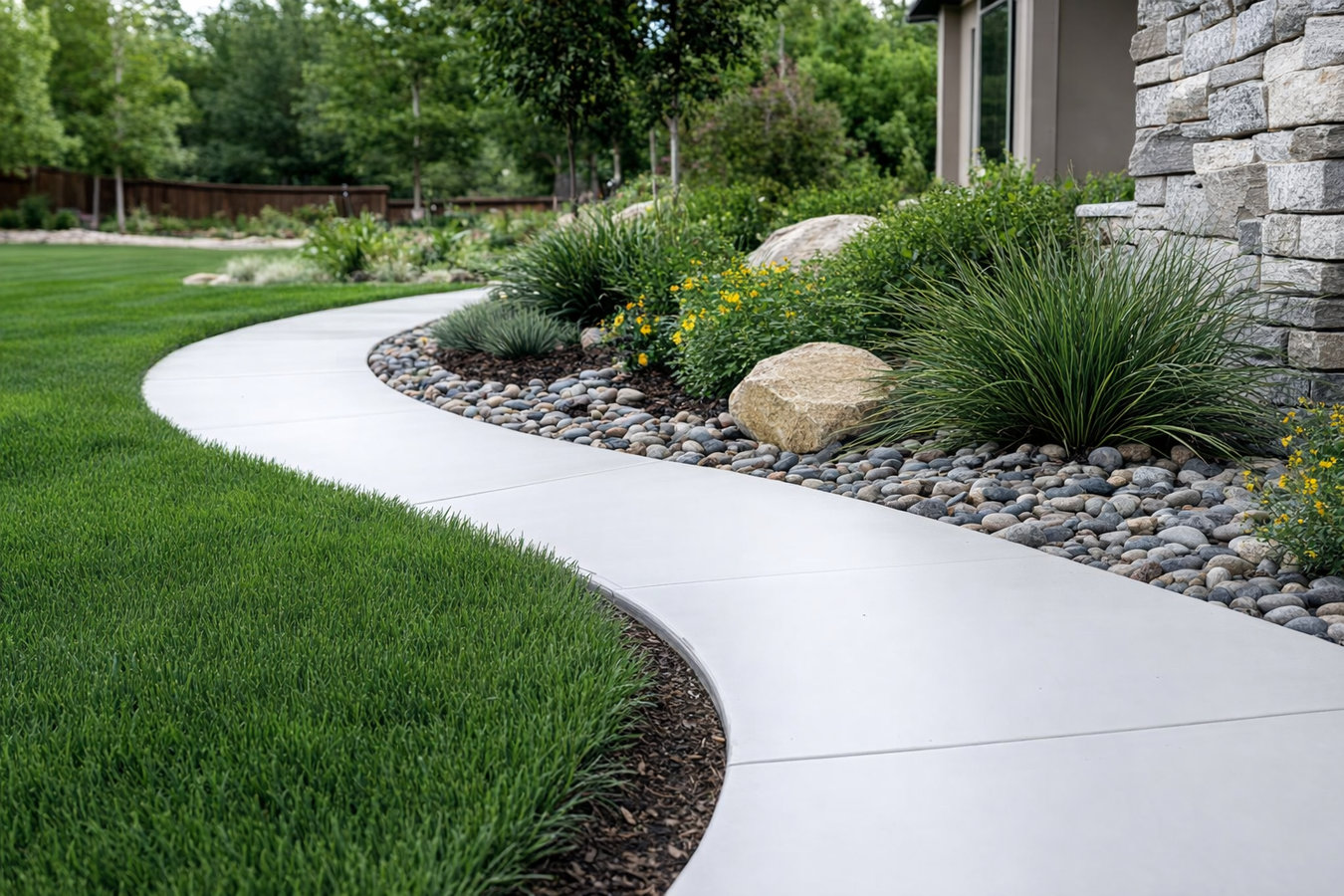
Heaved slabs, pooling water, and city notices are problems that get worse each winter. A new concrete sidewalk, built with the right base and grade, solves all three and stays solid for decades.
Concrete sidewalk building in Newton involves removing the old surface, compacting a gravel base, setting forms, and pouring a 4-inch slab with control joints — most residential walkways are completed in one to two days of active work, with full use restored after about a week.
If your current walkway is heaving, cracking, or sitting below the level of the curb, the issue is usually the base, not just the surface. Patching individual slabs buys time, but it does not fix the underlying cause. Newton's older neighborhoods — from Newtonville to Chestnut Hill — have housing stock where original sidewalks are decades overdue for replacement.
A new sidewalk also pairs naturally with a concrete driveway project. Both surfaces share the same preparation process, and doing them together in one mobilization is typically more efficient than scheduling them separately.
A lip of more than half an inch between slabs is a tripping hazard. In Newton, this is often caused by tree roots pushing up from below or soil shifting through years of freeze-thaw cycles. The city inspects front sidewalks and can issue notices requiring repair.
Small hairline cracks are normal in old concrete, but cracks that grow wider over time mean the slab is actively moving. Newton's winters force water into those cracks, which freezes and expands them further. A crack that looks minor in October can be a broken slab by April.
A properly built sidewalk sheds water to the sides. Puddles on the surface, or water draining toward your foundation, mean the grade is wrong. Poor drainage is both a safety issue and a signal that the base may be failing.
If the top layer is chipping away in thin pieces, years of deicing salt combined with freeze-thaw damage have caused spalling. Once spalling is widespread, patching accelerates rather than slows the deterioration. Replacement is the better long-term investment.
Vetra Newton Concrete builds and replaces concrete sidewalks for residential properties throughout Newton. Every project includes the permit application to Newton's Department of Public Works where the walk borders the street, demolition and haul-away of the old surface, gravel base preparation, forming, and the finished pour.
Sidewalks are poured at four inches deep for standard foot traffic. Where a sidewalk crosses a driveway apron and vehicles will roll over it, we increase thickness to six inches in that zone. Control joints are pressed or cut at regular intervals to guide any future cracking into straight, planned lines rather than random fractures across the surface. The standard finish is a broom texture for slip resistance; smooth or exposed aggregate finishes are available on request.
Newton's tree-lined neighborhoods present a recurring challenge: roots from large street trees push up slabs from below. We assess the root situation during every estimate visit because pouring new concrete over an active root problem simply means the same damage returns in a few years. For properties where a new sidewalk connects to entry stairs, our concrete steps construction service handles that transition cleanly.
Suits most residential front-yard and backyard sidewalk replacements.
For walkways that cross a driveway where vehicles roll over the surface.
For homeowners who want more visual texture while keeping a functional surface.
For properties where existing tree roots are causing or contributing to slab movement.
Newton averages more than 50 freeze-thaw cycles per year, meaning temperatures regularly cross the freezing point throughout winter and early spring. Each cycle pushes water in and out of the concrete surface, gradually chipping and pitting it. A contractor who builds sidewalks here must account for this climate in the concrete mix specification and the sealing recommendation, not just in the pour itself.
Newton's extensive urban tree canopy is one of the city's defining characteristics. It is also one of the most common causes of sidewalk damage. Large street trees planted decades ago now have root systems that can push a concrete slab several inches out of plane. Addressing this at the estimate stage, before the forms are set, is the only way to avoid repeating the same problem after the new concrete cures.
Soil conditions also vary by neighborhood. Lower-lying areas near the Charles River have softer, more moisture-prone soils that require additional base depth and compaction. We work across Newton's villages and neighboring communities, including Somerville, Cambridge, and Brookline.
We respond within 1 business day to schedule a site visit. No price is given over the phone — site conditions, root proximity, and demolition scope all affect the cost and must be assessed in person.
We walk the area with you, check drainage and root conditions, and deliver a written estimate separating demolition, base prep, the pour, and any permit fees. You know every cost before committing.
If your walkway borders the street or public right-of-way, we apply for the permit with Newton's Department of Public Works before the crew arrives. Ask for the permit number before work begins.
The crew removes the old concrete, grades and compacts the base, sets forms, and pours. Control joints are pressed in during finishing. We walk the completed surface with you before calling the job done.
We respond within 1 business day. There is no obligation after the estimate — you receive a written breakdown of every cost. After you submit, someone from our office will call to schedule a free on-site visit.
(617) 634-8563We work across Newton and 11 surrounding communities. That range means we have navigated the permit requirements, soil conditions, and housing ages that vary from neighborhood to neighborhood across the region.
We evaluate tree root proximity during the estimate visit and discuss options before setting forms. This step prevents repeating the same damage. Newton's urban forestry guidelines also protect street trees, and we work within those rules. Newton Urban Forestry provides guidance on street tree protections.
Unpermitted sidewalk work in Newton can create problems when you sell your home or if the city conducts an inspection. We handle the permit application with the Newton Department of Public Works on every project that requires it, so your new sidewalk is documented from day one.
The gravel base is what keeps a sidewalk level over decades of freeze-thaw cycles and root activity. We walk you through the base work before we pour so you can see what is underneath, not just what is on top. According to the Portland Cement Association, proper base preparation is the most important factor in the long-term performance of concrete flatwork.
Every sidewalk we build in Newton starts with the permit and ends with a walkthrough. The steps in between — demolition, base prep, forming, pour, joints, and drainage grade — are done the same way on every project because that is how you get a surface that is still level and crack-free a decade from now.
Pair a new sidewalk with a full driveway replacement to unify your front yard with one consistent surface that holds up through Newton winters.
Learn moreConnect a new front walkway to your entry with concrete steps built to the right height, slope, and finish for safe year-round use.
Learn moreContact us now before the fall season books up, and get a written estimate with every cost itemized before you commit.